| |  |
Hybrid LES-RANS
|

| Researcher: |
Lars Davidson lada@chalmers.se |
| Publications: | [1-13], see references below |
| Start of project: | 2000 |
 INTRODUTION The main bottle neck for using Large Eddy Simulations at high Reynolds number is the requirement of very fine meshes near walls. Hybrid LES-RANS was invented to get rid of this limitation. In this method unsteady RANS (URANS) is used near walls and away from walls LES is used. The matching between URANS and LES takes place in the inner log-region. Our later work has been focused on improving standard LES-RANS. The improvement consists of adding instantaneous turbulent fluctuations (forcing conditions) at the matching plane between the LES and URANS regions in order to trig the equations into resolving that part of the turbulence that is resolvable on the given grid resolution. The turbulent fluctuations are taken either from channel DNS or synthesized homogeneous turbulence assuming a modified von Karman spectrum. THE APPROACH The object of hybrid LES-RANS is to get rid of the requirement of high near-wall resolution in wall-parallel planes. In the near-wall region (the URANS region), a low-Re number RANS turbulence model (usually an eddy-viscosity model) is used. In the outer region (the LES region), the usual LES is used, see Figure below. 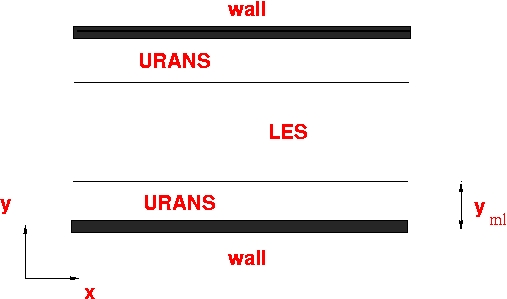
|
The idea is that the effect of the near-wall turbulent structures should be predicted by the RANS turbulence model rather than being resolved. The matching between the URANS region and the LES region usually takes place in the inner part of the logarithmic region. In the LES region, coarser grid spacing in wall-parallel planes can be used. In this region the grid resolution is presumably dictated by the requirement of resolving the largest turbulent scales in the flow (which are related to the outer length scales, e.g. the boundary layer thickness), rather than the near-wall turbulent processes. The unsteady momentum equations are solved throughout the computational domain. The turbulent RANS viscosity is used in the URANS region, and the turbulent SGS viscosity is used in the LES region. Although good results have been presented with hybrid LES-RANS, it has been found that the treatment of the interface between the URANS region and the LES region is crucial for the success of method. The resolved turbulence supplied by the URANS region to the LES region does not have any reasonable turbulent characteristics and is not representative of turbulence at all. This results in too poorly resolved stresses on the LES side of the interface and this gives a ramp - also referred to as a shift - in the velocity profile approximately at the location of the matching plane. The too small resolved stresses in the LES region is via the streamwise momentum balance in the URANS region translated into too a small wall shear stress. In our work we add fluctuations to the momentum equations at the interface. The turbulent fluctuations are taken either from DNS channel flow or synthesized homogeneous turbulence assuming a modified von Karman spectrum. Both isotropic and non-isotropic fluctuations have been evaluated. The object is to trig the equations into resolving turbulence. How large part of the turbulent spectrum that is resolved depends entirely on the resolution. 
REFERENCES - click  to view postscript file to view postscript file
"Hybrid RANS-LES: an Approach to make LES Applicable at High Reynolds Number", CHT-04: Advances in Computational Heat Transfer III, Keynote Lecture, G. de Vahl Davis and E. Leonardi (eds.), Norway, April 2004 (updated version in International Journal of Computational Fluid Dynamics, Vol. 19, No. 6, pp 415-427 2005, see below).
|
This page, HYBRID LES-RANS, should be part of a frames system at www.cfd-sweden.se/lada/projects/proind.html by  Webbmaster: Inga-Lena Ljungström ilj@flowsim.se |