BACKGROUND
Machine learning (ML) is a method which originally was used for teaching the algorithm to classify sets of data.
- Photographs where the machine learning algorithm should recognize an object,
e.g., traffic lights
- ECG signals
where the machine learning algorithm should analyse electrocardiogram (ECG) signals and
ecognize certain unhealthy conditions of the heart
- Detecting fraud for credit card payments
Machine learning methods such as
Support Vector Machines (SVM) and neural networks (NN) are used for solving this type of problems.
In turbulence modeling, input and output
are numerical values. Regression methods (SVR or NN) should be used. In my research I'm using
- Support Vector Regression (SVR) [1,3]
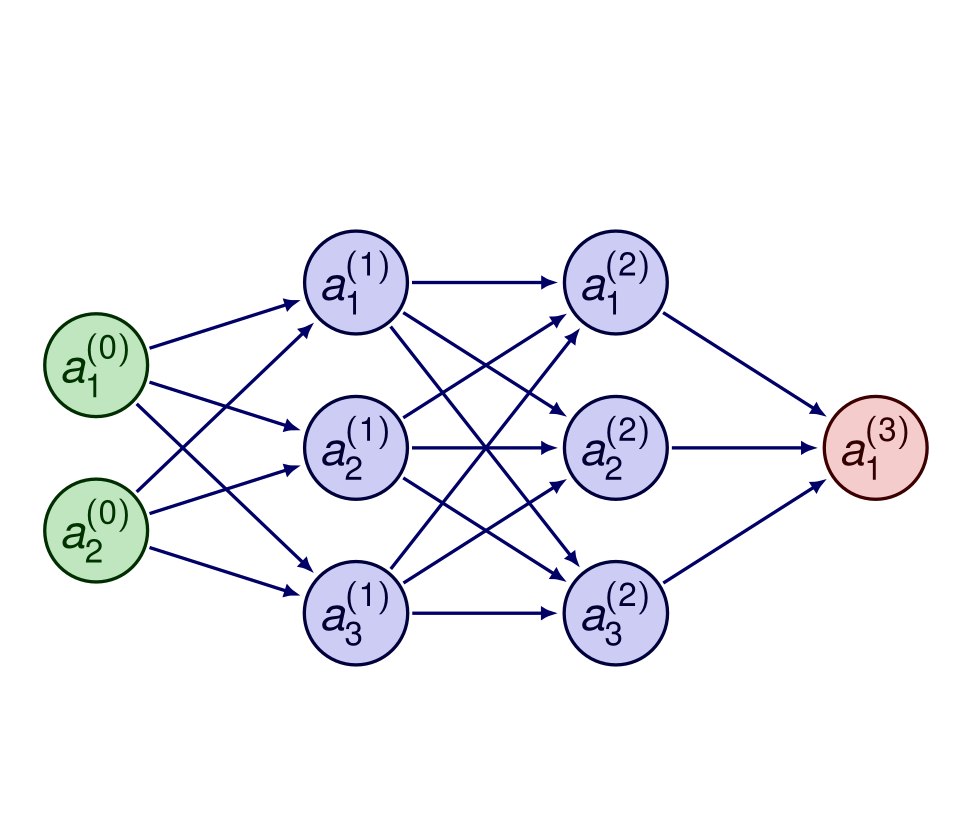
- Neural Network (NN) [4,5,8,9]
- Physics-Informed Neural Network (PINN) [7,8]
- Symbolic Regression
(pySR) for convering NN models to pySR models
- binary search trees (KDTree) [6]

REFERENCES
-
L. Davidson
"Using Machine Learning for formulating new wall functions for Large Eddy Simulation: A First Attempt",
Div. of Fluid Dynamics, Mechanics and Maritime Sciences,
Chalmers University of Technology, 2022.
→View PDF file
-
L. Davidson
"Using Machine Learning for formulating new wall functions for Large Eddy Simulation: A Second Attempt",
Div. of Fluid Dynamics, Mechanics and Maritime Sciences,
Chalmers University of Technology, 2022.
→View PDF file
-
L. Davidson
"Using Machine Learning for formulating new wall functions for Detached Eddy Simulation",
ERCOFTAC symposium on Engineering, Turbulence, Modelling and Measurements (ETMM14),
in Mini-Symposium: Machine learning for turbulence, Barcelona, Spain 6th - 8th September 2023;
Chalmers University of Technology, 2022.
→View PDF file
-
L. Davidson
"Using Machine Learning for Improving a Non-Linear k-eps Model: A First Attempt",
Div. of Fluid Dynamics, Mechanics and Maritime Sciences,
Chalmers University of Technology, 2023.
→View PDF file
-
L. Davidson
"Using Neural Network for Improving an Explicit Algebraic Stress Model in 2D Flow",
CUSF 2024, Proceedings of the Cambridge Unsteady Flow Symposium",
Springer, Editors: J. C. Tyacke and N. R. Vadlamani, 2024 (to appear)
→View presentation
→View PDF file
→Proceedings
→Download code
-
L. Davidson
"Hybrid LES/RANS for flows including separation: A new wall function using Machine Learning based on binary search trees",
Journal of Turbulence, 2025.
→Get article at publisher
→Download Python script and databases
-
L. Davidson
"Using Physical Informed Neural Network (PINN) to Improve a k-omega Turbulence Model",
ERCOFTAC Symposium on Engineering Turbulence Modelling and Measurements (ETMM-15),
Dubrovnik on 22-24 September 2025.
→Download Python script and databases
-
L. Davidson
"Using Physics Informed Neural Network (PINN) and Neural Network (NN) to Improve a k-omega Turbulence Model",
Journal of Turbulence, https://doi.org/10.1080/14685248.2026.2665148, 1-22, 2026.
→Download paper, Python scripts and CFD codes
-
L. Davidson
"Understanding Autograd and Neural Network in PyTorch",
Div. of Fluid Dynamics, Mechanics and Maritime Sciences,
Chalmers University of Technology, 2025.
Download paper
-
L. Davidson
"pyCALC-LES: A Python Code for DNS, LES and Hybrid LES-RANS"
Div. of Fluid Dynamics, Mechanics and Maritime Sciences,
Chalmers University of Technology, 2022.
→Download pyCALC-LES
|